


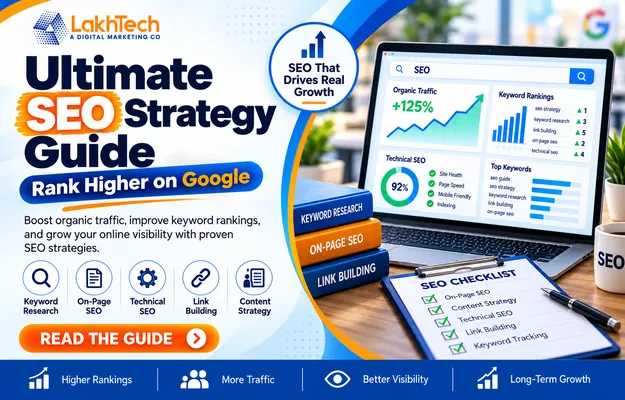

Most businesses start their SEO strategy backwards. They chase a list of tactics, publish a few blog posts, buy some backlinks, and wonder months later why nothing’s moved. Search engine optimization doesn’t work like that anymore, if it ever really did. In 2026, ranking well means getting the fundamentals right in the correct order, and it also means thinking beyond the traditional blue-link results altogether.
This guide walks through what a proper SEO strategy actually looks like today, including where it’s heading next.
Why Does Order Matters?
It’s tempting to jump straight to content or link building because they feel like the “real” work. But a technically broken site undermines everything built on top of it. If search engines can’t crawl, render, or index your pages properly, the best content in the world won’t get seen. The sensible order is: fix technical blockers first, match content to what people actually want, then build authority through links and reputation. Skipping ahead usually means redoing work later.
It also helps to set realistic expectations from the start. SEO is not a paid ad campaign that shows results within days. Most genuine improvements in ranking take somewhere between three and twelve months to show up clearly, depending on competition and how much work the site needs. Businesses that plan around that timeline tend to stick with the process long enough to actually see it pay off.
Technical SEO: The Foundation Nothing Else Works Without
Technical SEO covers everything happening behind the scenes that lets search engines crawl, render, and understand your site properly. Think of it as what’s under the bonnet rather than what visitors actually see.
Core Web Vitals still carry real weight. Google measures three specific things: Largest Contentful Paint (how fast your main content loads, aim for under 2.5 seconds), Interaction to Next Paint (how quickly your site responds when someone clicks or taps, aim for under 200 milliseconds), and Cumulative Layout Shift (whether elements jump around while the page loads, aim for under 0.1). A site that fails these consistently sends visitors away and search engines take notice.
HTTPS is non-negotiable. Every page should load securely. If any of your pages are still on HTTP, that’s a straightforward fix with real consequences for both trust and ranking.
Crawlability comes before everything. Your XML sitemap should be submitted and accurate, your robots.txt file shouldn’t be accidentally blocking pages you want indexed, and Google Search Console should be verified and actively monitored. None of your other SEO work matters if search engines can’t find and read your pages in the first place.
Structured data is no longer optional polish. Schema markup helps search engines, and increasingly AI-powered search tools, understand exactly what’s on a page. A site that’s technically clean but has no structured data is leaving visibility on the table, both in traditional search results and in the AI-generated answers now sitting above them.
Mobile usability is the baseline, not a bonus. Google uses the mobile version of your site to rank results, so anything that works fine on desktop but breaks or slows down on a phone is actively costing you.
Keyword Research: Finding What People Actually Search For, and Why They’re Searching
Keyword research is the process of identifying the specific terms and phrases your potential customers type into Google, and it should shape almost every other decision in your content strategy. But finding the words is only half the job. The other half is understanding search intent, what the person actually wants when they type that phrase.
Search intent generally falls into three buckets: informational (someone looking to learn something), commercial (someone comparing options before deciding), and transactional (someone ready to buy or book). Matching content to the right intent matters more than matching it to the right keyword. Someone searching “best travel credit cards” isn’t looking for a single product page, they want comparisons, pros and cons, and enough detail to make a decision. Give them that, and they stay on the page. Give them a sales pitch instead, and they leave, which sends its own signal back to Google.
In practice, keyword research still starts in a familiar place:
- List the core topics, products, or services relevant to your business
- Use Google’s autocomplete and “People Also Ask” boxes to see how real searches are phrased
- Check Google Search Console for the queries already bringing people to your site
- Group keywords by intent before mapping each one to a single, dedicated page
- Example: a solicitor’s firm might find that “conveyancing solicitor” is a transactional search, while “how long does conveyancing take” is informational. Both deserve their own page, written for what that specific searcher needs, rather than being crammed onto one generic services page.
On-Page SEO: Optimising What’s Actually on the Page?
On-page SEO covers everything within your control on a specific page, content, structure, and HTML elements, that helps both users and search engines understand what that page is about.
- The essentials haven’t changed much in principle, even if the standards have risen:
- Clear, accurate title tags and meta descriptions that reflect what the page actually delivers
- A logical heading structure (H1 through H3) that organises content the way a reader would expect
- Internal links connecting related pages, and a small number of external links to relevant, trusted sources
- Fast-loading, properly compressed images with descriptive alt text
The bigger shift in 2026 is what separates a page that ranks from one that doesn’t: information gain. Google increasingly favours pages that add something genuinely new, an insight, a perspective, a piece of first-hand experience, that isn’t already sitting in the ten results above it. Rewriting what’s already ranking in slightly different words doesn’t move the needle anymore. Adding something the competition missed does.
Off-Page SEO: Building Trust Beyond Your Own Site
If on-page and technical SEO are about proving your site works well and answers the question, off-page SEO is about proving the rest of the internet trusts you. It covers everything that happens outside your own website, backlinks, brand mentions, reviews, and social visibility, that signals authority to search engines.
Backlinks remain one of the strongest trust signals, but quality has always mattered more than volume. A single link from a genuinely relevant, authoritative site is worth more than dozens from low-quality directories. The links that actually help are earned because other sites find your content genuinely worth referencing, not purchased or swapped.
Brand mentions count even without a link. When your business is mentioned by name on a reputable site or in the press, that still signals credibility, even without a clickable link attached.
Reviews and social signals add up too. Positive reviews on Google and industry-relevant platforms, combined with genuine engagement on social media, build the kind of reputation that search engines increasingly factor into how trustworthy a brand appears.
Local SEO: Winning the Searches That Matter Most Nearby
For any business with a physical location or a defined service area, local SEO deserves its own focus within the wider strategy. When someone searches for a business nearby, Google often shows a local pack, a small cluster of results at the very top of the page, and getting featured there matters because plenty of searchers never scroll past it.
Getting into that local pack starts with a fully completed Google Business Profile: accurate address, phone number, and hours, the correct business category, real photos, and a steady flow of genuine reviews. The more complete and active the profile, the more confidence Google has in showing it to nearby searchers. For a business serving multiple regions, such as one operating across both India and the UK, this also means being deliberate about location-specific pages rather than relying on one generic site to represent both markets.
Ranking Beyond the Blue Links
Here’s the part most SEO guides still miss. Ranking on Google in 2026 no longer means competing for one list of ten results. Google’s own AI Overviews now sit above traditional results for a huge share of searches, and tools like ChatGPT and Perplexity are becoming genuine alternatives to a search bar for many people. Being visible in one and invisible in the other is quickly becoming a real problem, not a hypothetical one.
The good news is that most of what earns visibility in AI-generated answers is the same work that earns strong traditional rankings: clean structured data, clear and well-organised content, genuine expertise, and pages that directly and honestly answer the question being asked. Businesses that treat this as a separate, optional add-on are already behind. Businesses that build it into the same strategy from the start won’t need to catch up later.
Bringing an SEO Strategy Together
None of these elements work well in isolation. A technically flawless site with no content strategy won’t attract search traffic. Brilliant content on a technically broken site won’t get crawled properly. Strong backlinks pointing to thin, unhelpful pages won’t hold up over time. A genuine SEO strategy treats technical health, keyword research, on-page content, off-page authority, local presence, and AI search visibility as one connected system, each one reinforcing the others, rather than a checklist to work through once and forget.
Here’s a natural version with LakhTech Solutions and relevant SEO keywords added without keyword stuffing:
Final Thoughts
Ranking higher on Google in 2026 isn’t about chasing the latest SEO trick or gaming a single ranking factor. At LakhTech Solutions, we believe long-term SEO success comes from building a website that is technically sound, genuinely useful to your audience, and supported by strong trust signals across the web.
A successful SEO strategy should start with a strong technical foundation, followed by high-quality, search-focused content that answers what people are actually looking for. From technical SEO and on-page SEO to content marketing, local SEO, and link building, every part of the strategy should work together to improve organic visibility and attract relevant traffic.
Search behaviour is also changing, with users increasingly discovering information through Google Search, AI-powered search, and other digital platforms. That means businesses need to focus on being visible wherever their customers are searching, not just in traditional Google results.
At LakhTech Solutions, our approach to digital marketing and SEO services focuses on sustainable growth rather than quick fixes. Build the right foundation, create content around real customer needs, strengthen your website’s authority, and give your SEO strategy time to work. Rankings tend to follow as a result of consistent, valuable work rather than being a target chased directly.