


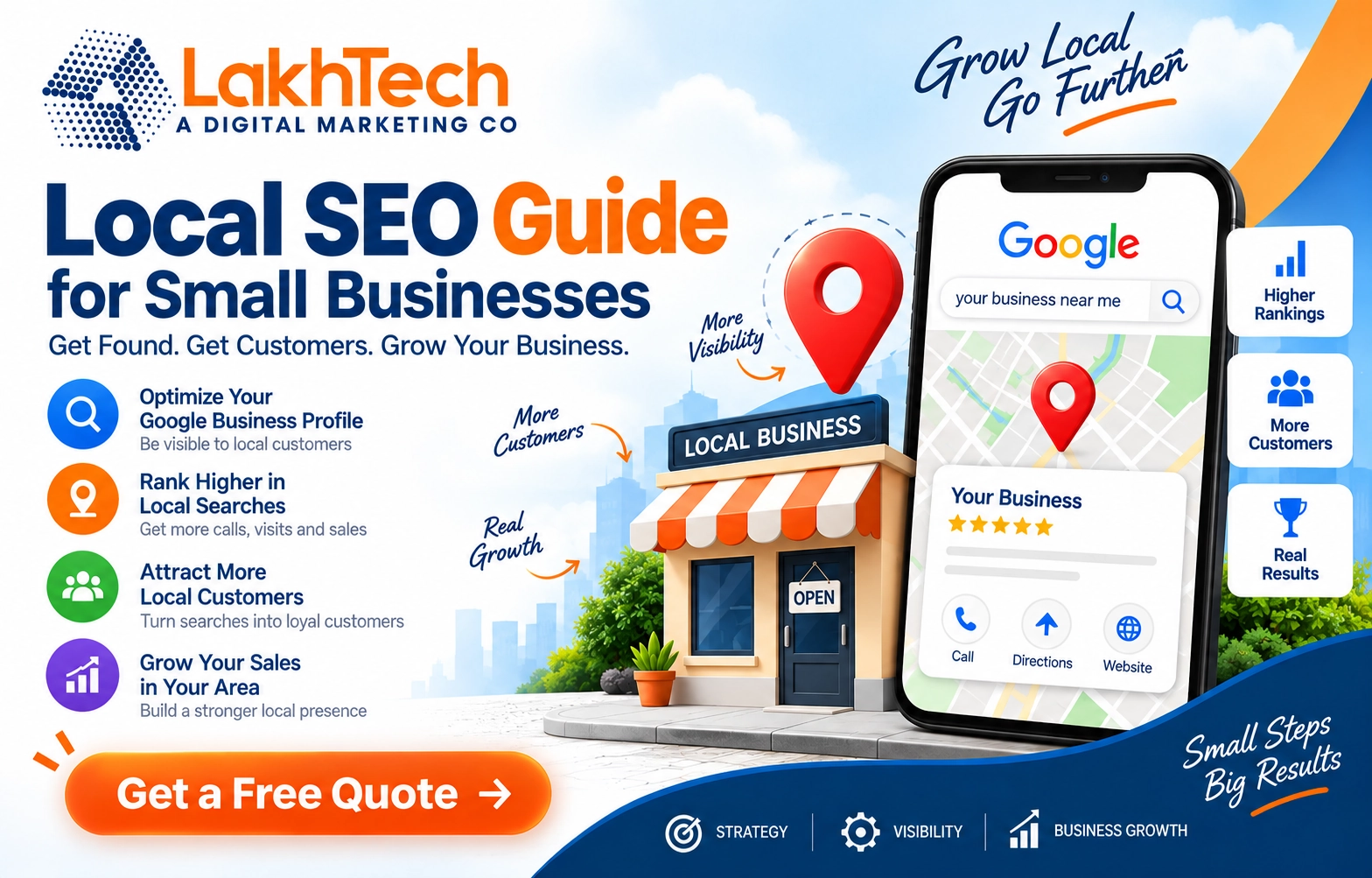

If you run a small business with a physical location or a defined service area, Local SEO is probably doing more for your bottom line than any other marketing channel you’re paying for. Nearly half of all Google searches carry local intent, and when someone searches “plumber near me” or “best coffee shop downtown,” Google doesn’t hand them a list of ten blue links. It hands them a map with three businesses on it. If you’re not one of those three, you’re invisible at exactly the moment someone was ready to buy.
This guide walks through what actually moves the needle: your Google Business Profile, Google Maps rankings, local keyword research, and the on-site work that ties it all together. No jargon, just what to do and why.
What Local SEO Actually Means?
Local SEO Services is the practice of optimising your online presence so your business shows up when people nearby search for what you offer. It’s different from standard SEO because it factors in geography, not just relevance. Google’s local ranking system leans on three core signals:
- Relevance, how well your business matches what someone typed
- Distance, how close you are to the person searching
- Prominence, how well-known and well-reviewed your business is
You can’t do much about distance. But relevance and prominence are entirely within your control, and that’s where the rest of this guide focuses.
Google Business Profile: Your Most Important Local SEO Asset
Your Google Business Profile (GBP), formerly Google My Business, is the single biggest lever for local visibility. It’s the free listing that shows up in Google Maps and the local pack (those three map results at the top of relevant searches), and for many small businesses it gets more clicks than the actual website.
Claim and verify your listing first.
This sounds obvious, but plenty of businesses either never claim their profile or let it sit unverified for months. An unverified listing can’t be fully edited and won’t earn the trust signals Google rewards.
Fill in every field, not just the basics.
Business name, address, phone number, website, hours, and categories are the starting point. But go further:
- Choose a primary category that matches your core business exactly (a bakery should be “Bakery,” not the vague “Food Establishment”), then add relevant secondary categories
- Write a complete business description that naturally includes what you do and where you serve, without keyword-stuffing it
- Add your services or products with actual descriptions, not just a name each
- Upload real photos regularly, of your storefront, your team, your work, not just stock images
Keep your hours accurate, including holidays. This matters more than most business owners realise. Google factors your live operating status into local pack rankings in real time. A profile that shows “Closed” during your actual opening hours because you forgot to update a holiday schedule can drop out of the local pack entirely, even temporarily, while a competitor that’s genuinely open gets the spot instead.
Use Google Posts. These are short updates, offers, or events that appear directly on your profile. A photo, a description under 300 words, and a call-to-action button linking back to your site is the standard format. They expire after six months, but the engagement they generate keeps paying off.
Respond to every review. Not just the bad ones. A steady stream of reviews, and visible, thoughtful responses to them, is one of the clearest prominence signals Google uses. A café that replies to a five-star review with a genuine thank-you and to a three-star review with an actual fix builds far more trust than one that ignores both.
Google Maps Optimization: Winning the Local Pack
Google Maps SEO overlaps heavily with GBP optimisation, since your Maps listing pulls directly from your profile, but there are a few things worth calling out specifically.
NAP consistency is non-negotiable.
Your Name, Address, and Phone number need to match exactly across your website, your GBP listing, and every directory you’re listed on (Yelp, Bing Places, industry-specific directories). Even small inconsistencies, like “St.” on one platform and “Street” on another, can quietly undermine how much Google trusts your listing.
Avoid listing duplications Learn how local SEO helps small businesses improve Google visibility, attract nearby customers, increase website traffic, and generate more calls, enquiries.
If your business shares a building, a phone number, or nearly identical categories with another listing, Google’s similarity filters may hide one of you from the map pack entirely. This is a common, easily missed issue for businesses that have moved locations or rebranded without cleaning up old listings.
Build local citations.
A citation is any online mention of your business name, address, and phone number, whether or not it links back to your site. Local directories, chamber of commerce listings, and industry associations all count. The more consistent, accurate citations you have, the stronger the prominence signal.
Encourage geo-relevant engagement. Reviews that mention your city or neighbourhood, photos taken at your actual location, and check-ins all reinforce that your business is a genuine, active presence in the area, not just a listing on a map.
Example: An independent hardware store in Leeds that keeps its GBP fully updated, responds to reviews within a day or two, and posts photos of new stock weekly will typically outrank a bigger chain store nearby that’s left its profile untouched for a year, even with a smaller marketing budget. Local pack rankings reward activity and accuracy far more than size.
Local Keyword Research: Finding What Your Customers Actually Search
Local keyword research is about finding the exact phrases people in your area type into Google when they need what you offer. It’s more specific than general keyword research because you’re combining three elements:
- The service or product, such as “plumber,” “wedding photographer,” “vegan bakery”
- An intent modifier, such as “emergency,” “affordable,” “best,” “open now”
- A location, a city, neighbourhood, or the implicit “near me”
Explicit vs. implicit local keywords.
Explicit keywords name a location directly, like “dentist in Manchester” or “best Italian restaurant Camden.” Implicit keywords don’t mention a place but still carry local intent, like “coffee near me” or “emergency electrician.” Google uses the searcher’s location, IP address, and device signals to localise these results automatically, so you need to rank for both types.
Where to find these keywords:
- Google Autocomplete, start typing your service into Google and see how it finishes the phrase
- Google Business Profile Insights, this shows the actual search queries people used to find your listing, which is often the most reliable source you have
- Competitor pages, search your main keyword, open the top few ranking sites, and look at their headings for the phrases they’re targeting
- “People Also Ask” boxes, these reveal the exact questions people are searching around your topic
Example: A renovation company in Bristol might discover through autocomplete and GBP Insights that customers search “kitchen renovation Bristol,” “bathroom remodel near me,” and “how much does a kitchen renovation cost.” That’s three different pieces of content: a service page for kitchen renovations, a service-area page targeting “near me” intent, and a blog post answering the pricing question. Each keyword gets its own dedicated page rather than being crammed onto one.
Don’t dismiss low search volume in small markets. If you’re a genuinely local business, a page for your town or service area belongs in your site structure even if a keyword tool shows minimal volume. Search tools often underestimate demand in smaller towns, and if you’re physically located there, you should still be found there.
Bringing It Together: On-Page Local SEO
Your Google Business Profile and Maps presence do a lot of heavy lifting, but they work best alongside a website that reinforces the same signals.
- Create a dedicated page for each service and each location you serve, rather than one generic page trying to rank for everything
- Include your city or service area naturally in page titles, headings, and body content, not stuffed in awkwardly, but present where a real customer would expect it
- Embed a Google Map on your contact page and make sure your NAP details on the page match your GBP listing exactly
- Collect and display reviews on your site, not just on Google, to reinforce trust for visitors who land there first
Final Thoughts
Local SEO helps small businesses connect with nearby customers when they are searching for products or services. An accurate Google Business Profile, consistent business details, genuine reviews, and useful website content can strengthen your local visibility and encourage more calls and enquiries.
With LakhTech Solutions local SEO services, you can develop a strategy tailored to your location, audience, and business goals. From Google Business Profile optimisation to local keyword targeting, LakhTech helps make your business easier to find. Contact LakhTech Solutions to start improving your local online presence.